
Early County Court Records Access
Early County does not have a standalone county-branded public docket search for all court files. The access path is split among the Clerk of Superior Court, statewide provider links, GSCCCA clerk indexes, Probate Court, Magistrate Court, Blakely Municipal Court, and direct records requests. The Clerk of Superior Court is the main starting point for Superior, State, and Juvenile Court records, but juvenile files are restricted and are not treated like open adult case files.
For Superior Court and State Court, the Georgia Courts e-access page points users to provider systems and states that an account is required. Early Superior and Early State appear in that provider environment, with PeachCourt-style access used for case and document work. That route is useful when a person has a county, court, and exact case number. It is not the same as an anonymous, countywide public name search.
The GSCCCA search systems serve a different purpose. They cover clerk-maintained indexes such as real estate, lien, plat, PT-61, UCC, notary, and related records. Those records may be filed with the clerk, but they are not ordinary case dockets. When an online system does not show the record, the fallback is the Clerk of Superior Court at Suite C, by phone, mail, fax, email, or in person.
Georgia's open-records request example shows how a public records request should identify the requester and describe the records sought.
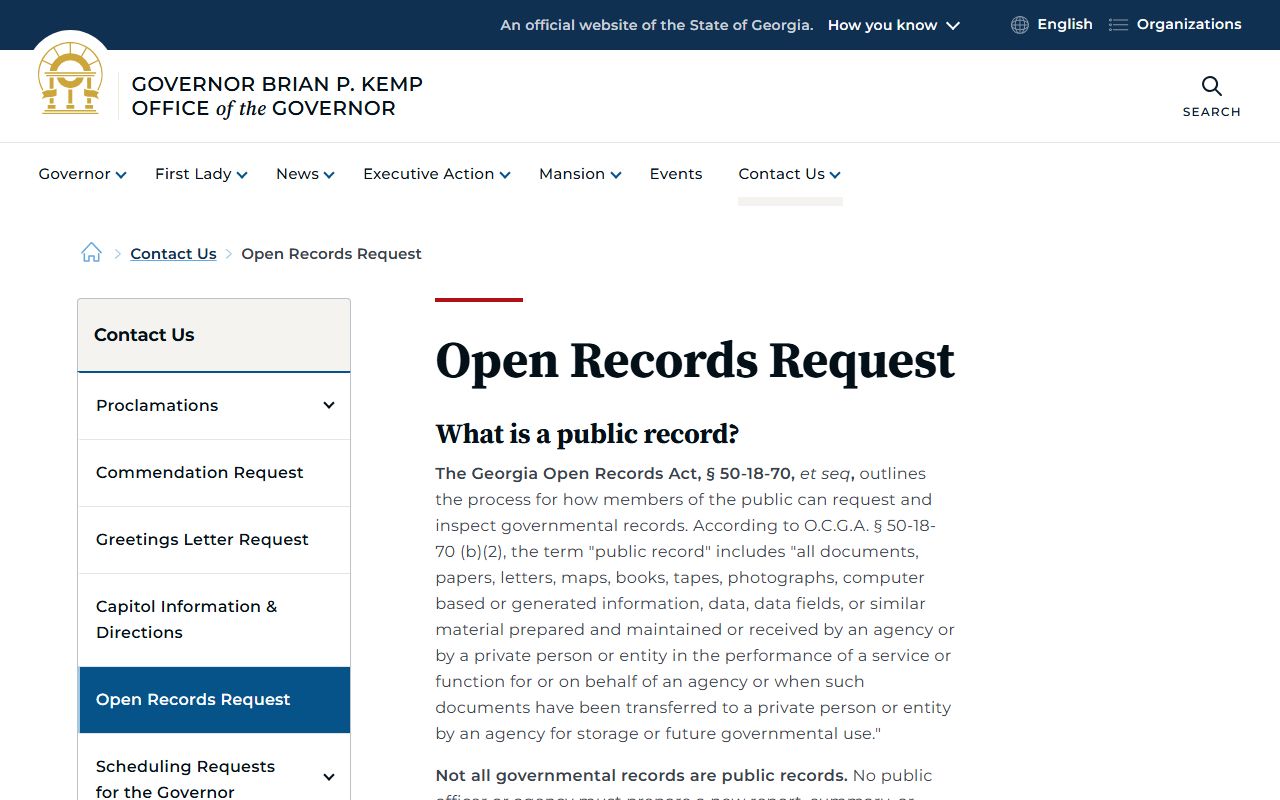
The image is relevant because Early County court record searches often end with a written request when provider access or clerk indexes do not return the needed file.
Search Early County Court Records
A good Early County court record search starts before the first portal is opened. Case type controls the route. Felony, divorce, equity, many civil, domestic relations, and lower-court appeal records route to Superior Court. State Court records can include misdemeanor and traffic matters where that court has jurisdiction. Probate records are handled by Probate Court. Magistrate Court is the likely starting point for many warrants, first appearances, dispossessory matters, and smaller civil claims. Blakely municipal citations use the city payment and Municipal Court channel.
The Clerk of Superior Court manages Superior, State, and Juvenile Court records for Early County. For older files, sealed material, restricted juvenile matters, or records not digitized through a provider, direct clerk help may be faster than repeating broad online searches. Use the case number exactly as printed on a summons, warrant, citation, filing receipt, provider notice, or clerk receipt. If there is no number, use party names, case type, approximate filing date, and court.
- Identify the court and case type first. Superior, State, Juvenile, Probate, Magistrate, and Municipal records follow different access paths.
- For Superior or State Court files, contact the Clerk of Superior Court or use Georgia Courts e-access if account-based provider access fits the search.
- Use PeachCourt only when account access and enough case identifiers are available.
- Use GSCCCA for deed, lien, plat, PT-61, UCC, and notary indexes rather than ordinary case files.
- For Probate Court, Magistrate Court, and Blakely Municipal Court matters, route the request to that court or office before asking the Superior Court clerk.
- If no online route works, submit a clear request with name, case number if known, date range, record type, and whether plain or certified copies are needed.
Early County Court Records Search Fields
The statewide provider route for Early County Superior and State records is gated by account access. The research did not find an Early County public screen that exposes an open, no-login field set. The fields below are the captured provider-access inventory from the Georgia Courts and PeachCourt route, with limits noted where the exact Early County search form was not publicly visible.
| Field Label | Type | Required | Options / Format Notes |
|---|---|---|---|
| Account / login | Login | Yes for Georgia Courts provider search | Georgia Courts e-access states an account is required. |
| County | Dropdown or selection | Likely yes | PeachCourt search guidance uses county. |
| Court | Dropdown or selection | Likely yes | Early Superior and Early State are listed separately by Georgia Courts. |
| Case number | Text | Strongly required | Provider guidance favors exact case-number search. |
| Party name | Text | Not confirmed for Early County | No Early-specific anonymous name-search fields were captured. |
| Document access | Account or payment | Varies | PeachCourt terms indicate eAccess document fees may apply. |
| Buttons | Action | Unspecified | Provider buttons were not fully captured because account login gates the search. |
PeachCourt is the provider platform tied to many Georgia court document workflows.
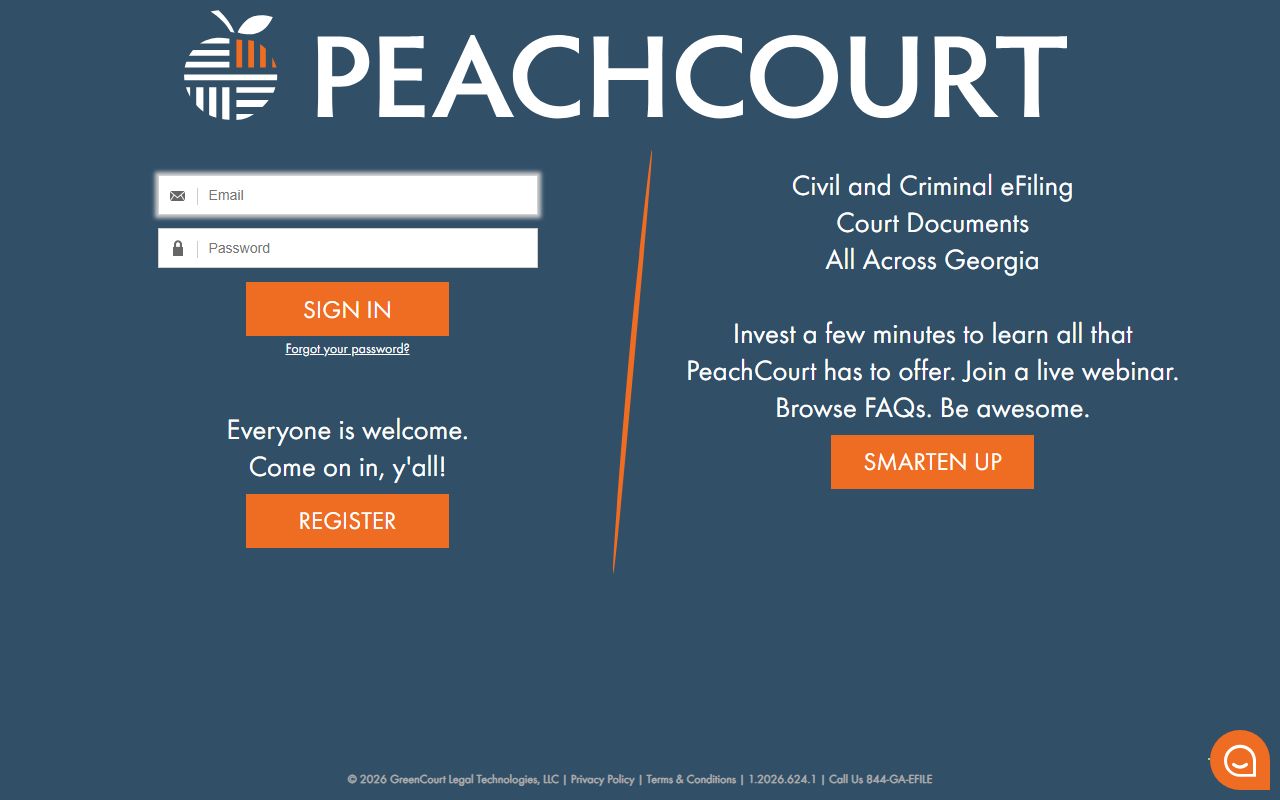
The provider image helps distinguish account-based court access from the open clerk-index searches available through GSCCCA.
Types of Early County Court Records
Early County court records are not one record type. Civil files may include complaints, answers, counterclaims, motions, orders, judgments, garnishments, civil appeals, name changes, liens, and trade-name matters. Criminal files may include charges, accusations or indictments, warrants and arrest papers when filed, bond orders, motions, plea papers, trial records, disposition, sentencing, probation conditions, and fines or costs. Georgia criminal history records held by GBI or GCIC are separate from the court case file kept by the clerk.
Family and probate records split by subject. Divorce is a Superior Court matter in Georgia, so Early County divorce decrees and case files should be requested from the Clerk of Superior Court. Probate records, including wills, estate petitions, administration, guardianship, conservatorship, inventories, and estate notices, belong with Probate Court. Traffic records can be in Blakely Municipal Court, State Court, or another local court channel depending on the issuing agency and offense.
- Civil records: pleadings, orders, judgments, garnishments, liens, name changes, trade names, and civil appeals.
- Criminal records: charging papers, bond entries, motions, pleas, hearings, disposition, sentence, and court costs.
- Family records: divorce filings, domestic relations forms, financial affidavits, parenting plans, and final judgments.
- Probate records: wills, estate petitions, letters, guardianship filings, conservatorship filings, and discharge petitions.
- Traffic and misdemeanor records: local citation files, State Court matters where applicable, and municipal ticket records.
- Clerk indexes: real estate, lien, UCC, plat, PT-61, notary, and trade-name materials searched through GSCCCA.
What Early County Court Records Show
An Early County court record may show the case number, court, filing date, case type, status, parties, attorneys, judge, docket events, motions, orders, hearing dates, disposition, sentence, judgment, costs, fines, bond, and documents. Because no sample public Early County case record was available without provider login, the field inventory should be read as a local court-record inventory rather than a promise that every online screen shows each field.
Case number formats were not found in an official Early County guide, so a requester should not guess or reformat the number. The clerk may need names, approximate filing date, case type, and court for older or manual searches. Provider systems are more likely to work when exact identifiers are available.
| Field | What It Shows |
|---|---|
| Case number | The court-assigned number from a filing notice, summons, citation, provider notice, or clerk receipt. |
| Court | Whether the matter is in Superior, State, Juvenile, Probate, Magistrate, or Municipal Court. |
| Filing date | The date the case or pleading was filed with the court. |
| Case type | Civil, domestic, criminal, probate, traffic, juvenile, magistrate civil, dispossessory, warrant, or similar category. |
| Status | Open, pending, disposed, closed, dismissed, transferred, sealed, restricted, or a similar court status. |
| Parties | Names and roles such as plaintiff, defendant, petitioner, respondent, estate, decedent, applicant, ward, minor, or garnishee. |
| Docket entries | Filings, hearings, notices, orders, continuances, judgments, sentencing, and disposition events. |
| Documents | Pleadings, motions, orders, judgments, warrants, bond orders, divorce decrees, probate petitions, letters, inventories, and certificates. |
| Financials | Filing fees, service fees, fines, court costs, restitution, bond, sheriff service, publication, and certified-copy charges. |
| Redactions | Protected identifiers, sealed pages, minor information, financial account numbers, and restricted juvenile or adoption materials. |
Early County Court Record Requests
The Clerk of Superior Court is the direct request channel for Superior, State, and administratively managed Juvenile Court files. The office is listed by GSCCCA as Early County Court, Clerk of Superior Court, at 111 Court Square, Suite C, P.O. Box 849, Blakely, GA 39823. The phone number is 229-723-3033, the fax number is 229-723-4411, and the Pataula Judicial Circuit lists email contact as gayle.anderson@gsccca.org.
Copy charges from the Pataula Superior Court fee source are useful when a file needs paper or certified copies. Uncertified copies with no assistance are listed at $0.50 per page. Uncertified copies with assistance are listed at $1 per page. Certified or exemplified copies are listed at $2.50 for the first page plus $0.50 for each added page. Filing fees and service fees are separate from copy fees.
| Request Item | Fee / Rule |
|---|---|
| Uncertified copies, no assistance | $0.50 per page |
| Uncertified copies, with assistance | $1 per page |
| Certified or exemplified copies | $2.50 first page, plus $0.50 each additional page |
| General civil filing | $210 plus applicable service fees |
| Family violence filing | No fee |
| Publication, divorce or name change | $80 |
Clerk of Superior Court
111 Court Square, Suite C
P.O. Box 849
Blakely, GA 39823
229-723-3033
Fax: 229-723-4411
Hours: 8:00 AM-5:00 PM, Monday-Friday
Email: gayle.anderson@gsccca.org
Early County Court Records Access Rules
Georgia law broadly favors access to public records, but court files follow both open-records law and court-file rules. O.C.G.A. 50-18-70 and 50-18-71 address public-records intent, request procedure, timing, inspection, and reasonable costs. Georgia's example says an agency may give a time and cost estimate when records are not ready at once and does not have to create a new summary if no record exists.
For court files, Uniform Superior Court Rule 21 states that court records are public unless access is limited by law or court order. Rule 21.6 and Rule 36.17 address protected identifiers and redaction. That means a file can be public while some pages or data fields are withheld. Social Security numbers, financial account numbers, protected addresses, dates of birth, and minor identifiers may be redacted.
Note: Public access does not guarantee instant online access; some Early County records still require clerk review, redaction, or copy processing.
Restricted Early County Court Records
Juvenile records are restricted under Georgia law. Early County Juvenile Court is managed through the Clerk of Superior Court for administrative purposes, but dependency, delinquency, CHINS, and juvenile traffic files are not ordinary public records. Parties, attorneys, agencies, and people with a court order may have different access rights from the general public.
Sealed and restricted criminal records also need separate handling. O.C.G.A. 35-3-37 allows some Georgia criminal-history information to be restricted from non-criminal-justice disclosure. For arrests after July 1, 2013, the person contacts the prosecutor for restriction review. For older arrests, the person applies through the arresting agency. If a prosecutor denies a request, Georgia.gov says the person may appeal to the Superior Court of that county within 30 days.
Adoption records are sealed under O.C.G.A. 19-8-23. Probate, Superior Court, or other court files involving adoption should not be treated as open unless a statute or court order allows access. Mental health, involuntary hospitalization, guardianship, and conservatorship files may also contain medical or capacity details that are sealed or partly restricted.
For live hearing dates and event history, Early County court dockets give a shorter event view than the full case file.